
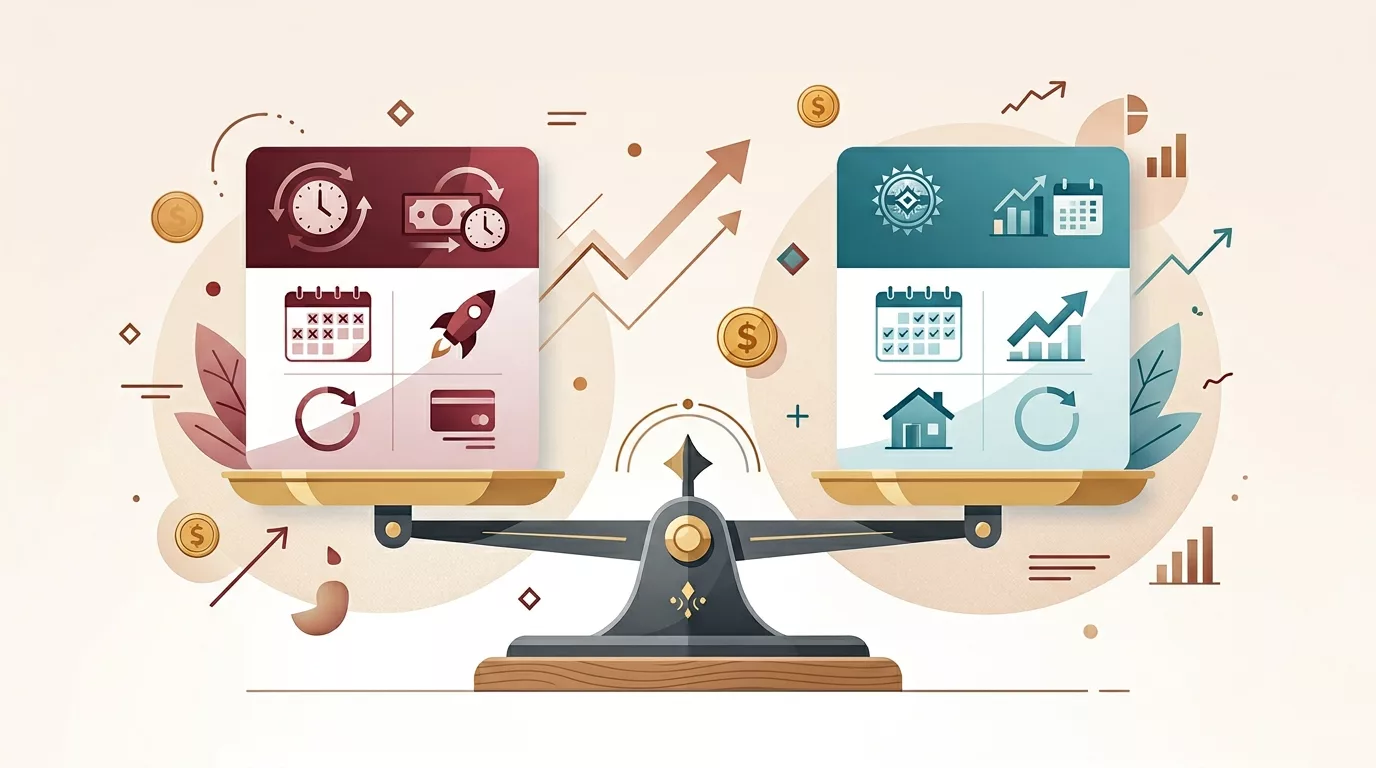
Tribal installment loans and payday loans are both marketed to borrowers with poor credit, but they differ on 3 critical dimensions: repayment structure, loan size, and the legal framework protecting you. Tribal loans offer $500–$5,000 repaid over 6–24 months with scheduled installments, while payday loans typically cap at $500 due back in a single lump sum within 14 days — a structural difference that has major consequences for your budget and total interest cost.
Defining Each Product
What Is a Payday Loan?
A payday loan is a short-term, small-dollar loan designed to be repaid in a single lump sum — typically on your next payday, which is usually two to four weeks away. Loan amounts are small, commonly ranging from $100 to $500, though some states allow up to $1,000. The lender charges a flat fee rather than a traditional interest rate: a typical fee is $15 to $30 per $100 borrowed.
Payday lenders are heavily regulated at the state level. More than a dozen states have effectively banned them, and many others cap fees or loan amounts. In states where they operate, they must be licensed, and state consumer protection laws apply fully. Before signing with any short-term lender, the NAFSA member directory can help you verify whether a tribal lender operates under established self-regulatory standards — a useful first check for any borrower.
What Is a Tribal Installment Loan?
A tribal installment loan is issued by a lender owned or affiliated with a federally recognized Native American tribe. Because tribes hold sovereign status, these lenders operate under tribal law rather than state law, meaning state interest rate caps and licensing requirements generally do not apply. Loan amounts run significantly higher — typically $500 to $5,000 — and repayment is structured across multiple scheduled payments over a term of 6 to 24 months. Federal laws like TILA, EFTA, and the MLA still apply. For a detailed breakdown of how the legal framework behind tribal lending works — including sovereign immunity and the arm-of-the-tribe test — see our explainer.
“The word ‘installment’ is not just a marketing term — it reflects a structurally different repayment model that carries real advantages over lump-sum debt, even at high rates.”
Side-by-Side Comparison
Here is a direct comparison of the most important features across both product types:
| Feature | Payday Loan | Tribal Installment Loan |
|---|---|---|
| Loan Amount | $100–$500 (up to $1,000 in some states) | $500–$5,000 |
| Repayment Term | 14–30 days (single payment) | 6–24 months (multiple payments) |
| Repayment Structure | Lump sum on next payday | Scheduled installments (bi-weekly or monthly) |
| Typical APR | 300%–400%+ (sometimes 500%+) | 200%–700%+ depending on lender |
| Regulation | State law (heavily regulated or banned in many states) | Tribal law + federal law (TILA, EFTA, MLA) |
| Availability | Varies by state — banned in 13+ states | Available in most states online |
| Credit Reporting | Rarely reports to bureaus | Some lenders report — can build credit |
| Rollover Risk | High — rollovers extend debt and fees rapidly | Lower — fixed schedule discourages rollovers |
| Dispute Resolution | State courts and regulators | Tribal arbitration (limited state recourse) |
| Military Protections (MLA) | Yes — 36% APR cap applies | Yes — 36% APR cap applies |
The APR Math: What You Actually Pay
APR comparisons can feel abstract until you see them in dollar terms. Here are two concrete examples at roughly comparable cost levels. The FDIC unbanked household survey documents how millions of Americans rely on alternative lending products precisely because conventional loan options require credit scores or banking history they don't have.
Payday Loan Example
You borrow $400 from a payday lender. The fee is $30 per $100 borrowed, so you owe $520 in 14 days. Your total cost of borrowing is $120.
To convert that to an APR: ($120 fee / $400 principal) = 30% cost over 14 days. Multiplied by 26 (the number of two-week periods in a year), that works out to approximately 390% APR. On a product designed for 14 days, that is the annualized cost.
If you cannot repay and roll over the loan, you pay another $120 fee for another two weeks — and the debt grows without any reduction in the principal.
Tribal Installment Loan Example
You borrow $1,000 at 299% APR over 12 months. Your monthly payment is approximately $228, and your total repayment is roughly $2,736 — meaning you pay about $1,736 in interest on a $1,000 loan.
That is an expensive loan. But compare it to rolling over a $1,000 payday loan eight times: at $30 per $100, each rollover costs $300 in fees, so eight rollovers alone cost $2,400 in fees with the original principal still unpaid. The installment structure forces actual paydown of the debt — a meaningful structural advantage. For context on what conventional borrowers pay, Bankrate personal loan rates show the national average APR for traditional personal loans, making the cost gap between mainstream and high-cost credit concrete. For a full review of tribal installment loan rates and APR calculations, including three worked examples, see our rates guide.
Compare Your Real Options
Check available tribal installment loan offers without a hard credit pull. Understand your terms before you decide.
The Rollover Trap vs. Structured Repayment
One of the clearest practical differences between these two products is how they handle a borrower who is struggling to repay.
With a payday loan, if you cannot pay in full on the due date, many lenders offer a rollover — you pay just the fee and extend the due date by another two weeks, with a new fee added. This can feel like relief in the moment, but it creates a debt trap: the principal never shrinks, fees stack, and the total cost balloons. Consumer financial research consistently identifies rollover chains as the primary driver of payday loan harm. The NY Fed consumer debt data tracks household borrowing stress over time, providing macroeconomic context for why short-term lending cycles affect broader financial stability.
Tribal installment loans are structured with a fixed repayment schedule. Each payment covers both interest and principal, so the balance decreases over time. If a borrower struggles, they may still have options to modify or defer a payment, but the architecture of the product does not encourage rolling debt indefinitely. That said, missing payments on a tribal loan can still trigger fees, and the automatic debit structure means a failed payment often results in NSF charges on top of lender fees.
Legal Protections: State vs. Federal
This is where the differences become most significant for borrowers who encounter problems.
Payday lenders in states where they operate are fully subject to state consumer protection laws. If a lender violates your state’s lending rules, you can file a complaint with your state banking regulator, and in many cases pursue remedies in state court. State attorneys general actively enforce these rules.
Tribal lenders, by contrast, are shielded by sovereign immunity from state enforcement actions. If a dispute arises, your loan agreement almost certainly routes resolution through tribal arbitration — meaning you cannot sue in your local state court, and in many cases you will have waived your right to participate in a class-action lawsuit. Federal protections (TILA, EFTA, FDCPA, the CFPB) still apply, but the practical enforcement pathways are narrower. If you believe a tribal lender has engaged in deceptive practices, you can file a complaint with the CFPB complaint portal or report fraud to the FTC fraud reporting portal
TILA — the Truth in Lending Act — requires both payday and tribal lenders to disclose the APR and total-of-payments figures before you sign. Understanding what the law requires lenders to show you is an important first step before reviewing any loan offer.
One area where both products are equal: the Military Lending Act imposes a hard 36% APR cap on both payday and tribal loans made to active-duty military and their dependents, with no exceptions.
Credit Reporting: A Hidden Advantage of Some Tribal Lenders
Traditional payday lenders rarely report payment activity to Equifax, Experian, or TransUnion. This means that even if you pay on time, you get no credit-building benefit — but if the debt goes to collections, that negative event can appear on your report. Before applying for either product, it is worth pulling your free reports from AnnualCreditReport.com to understand your current standing.
A growing number of tribal installment lenders do report to one or more of the major bureaus. For borrowers actively working to build or rebuild credit, this is a meaningful differentiator. Consistent on-time payments on an installment loan are one of the more effective ways to improve a credit score over a 12–24 month period — assuming the payments are affordable enough that you can make them reliably. See our guide on tribal installment loans for borrowers with poor credit for more on how income-based underwriting and credit reporting intersect.
Payment history accounts for 35% of a FICO score — the single largest factor. This is why an installment loan paid on time over 12 months can meaningfully move the needle for a thin-credit borrower, whereas a payday loan that never reports offers none of that benefit even after successful repayment.
Before you apply to any lender, ask directly: do you report to the major credit bureaus? Get the answer in writing if possible. Understanding exactly what drives score changes — including the weight given to payment history versus credit mix — is covered in depth by FICO score education resources from myFICO.
Which Product Is Right for You?
- check_circle Consider a payday loan if: You need a very small amount (under $400), you are certain you can repay the full balance in two weeks without financial strain, and you live in a state with strong consumer lending regulations.
- check_circle Consider a tribal installment loan if: You need a larger amount ($500–$5,000), you need several months to repay, a single lump-sum repayment is not realistic for your budget, or you want the potential of credit reporting.
- check_circle Consider neither if: You have access to a credit union, CDFI personal loan, employer advance, or 0% APR credit card offer. Both payday and tribal loans are high-cost products that carry real financial risk. Exhaust lower-cost alternatives first.
The clearest recommendation is this: whichever product you consider, calculate the total repayment amount before you sign — not just the monthly payment or the headline fee. If repaying the full amount would require you to skip other bills or borrow again next month, the loan will make your situation worse, not better. Both payday loans and tribal installment loans can serve a narrow legitimate purpose, but both demand honest self-assessment before you use them. Borrowers who want a safer alternative should also explore what tribal installment loans for emergency expenses look like compared to lower-cost options such as NCUA Payday Alternative Loans, which federal credit unions offer with APRs capped at 28%.
The key to using either product responsibly is matching the loan to an actual, one-time need with a clear repayment path — not as a recurring cash-flow supplement. If you find yourself needing repeated short-term loans to cover ongoing expenses, that signals a structural budget gap that high-APR borrowing will only worsen.
For borrowers who need even more flexibility, mission-driven small-dollar lenders listed in the CDFI Fund directory serve low-income communities with rates far below triple digits and are worth checking before committing to a high-APR product.
The Bottom Line
The core difference between tribal installment loans and payday loans is structural: tribal loans spread repayment over 6–24 months with each payment reducing the principal, while payday loans demand the full amount — typically $100–$500 plus a flat fee — in a single lump sum 14 days later. That structure makes tribal loans meaningfully less prone to the rollover debt trap that the CFPB has identified as the central harm of payday lending. Neither product is cheap — APRs on both commonly exceed 300% — but the installment model gives you a defined end date and a shrinking balance.
Before committing to either product, use the total-of-payments figure from your loan agreement — not the APR — to compare your real out-of-pocket cost. If you encounter problems with a lender, file a complaint with the Consumer Financial Protection Bureau at consumerfinance.gov/complaint or report fraud to the FTC at reportfraud.ftc.gov. Both agencies accept complaints about tribal and payday lenders and maintain public enforcement databases you can check before you apply.