
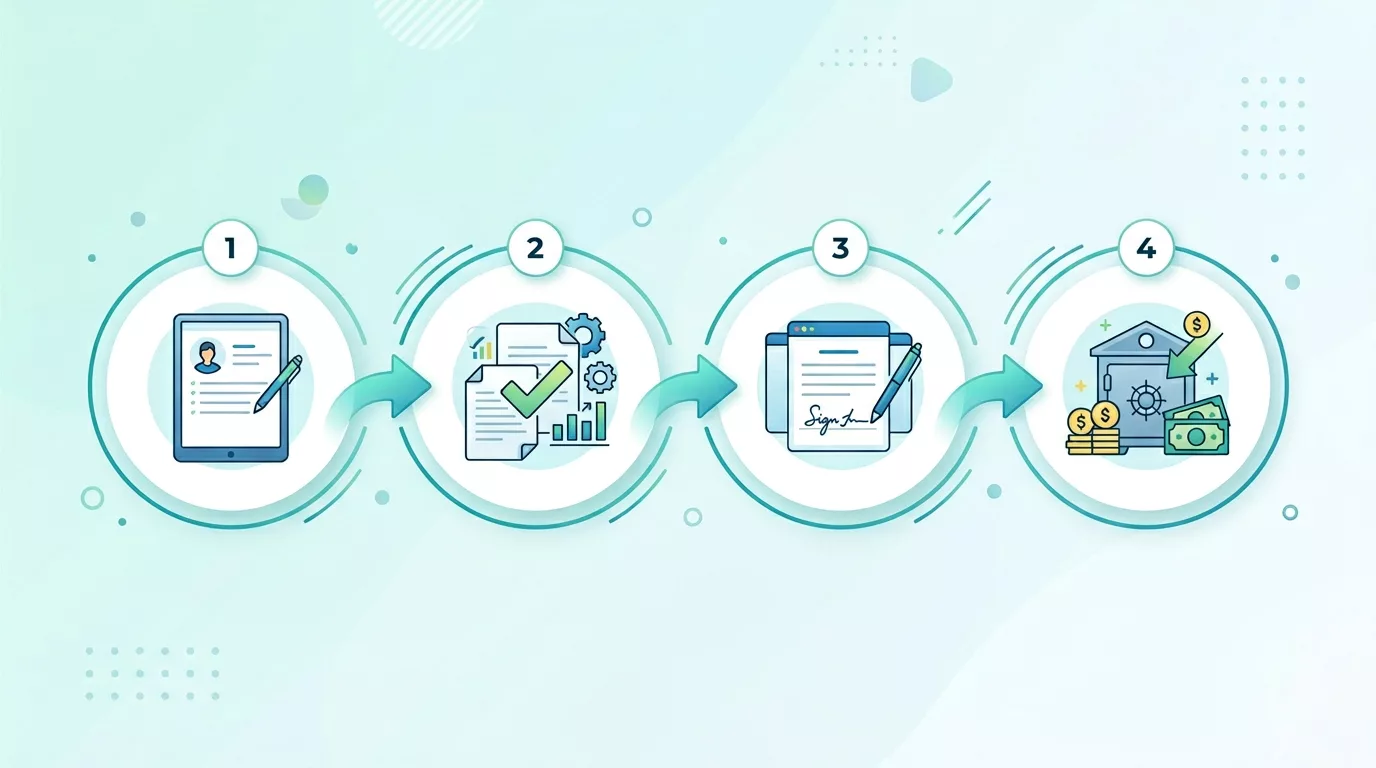
Tribal installment loans work through a fully online process that takes most borrowers 10 to 15 minutes to complete, with funds typically arriving in 1 business day. Repayment is structured across scheduled installments over 6 to 24 months — unlike a payday loan's single lump-sum due date — and APRs commonly range from 200% to 400%, so knowing every step before you sign protects you financially.
The Application: 5 Steps
Step 1 — Fill Out the Online Form
The application lives entirely online and takes most borrowers 10 to 15 minutes to complete. You'll provide your legal name, address, Social Security number, date of birth, and contact information. You'll also state how much you want to borrow and select your preferred repayment term if the lender offers a choice.
Step 2 — Provide Income Details
Tribal lenders require proof that you can repay. You'll enter your employer's name and your monthly or bi-weekly take-home pay. Some lenders ask you to upload a recent pay stub or bank statement; others pull this information automatically through a read-only bank data connection. Self-employed or gig workers typically need to provide 90 days of bank statements showing consistent deposits.
Step 3 — Link Your Bank Account
To receive funds and set up repayment, you'll provide your checking account and routing number. Most lenders use a secure third-party connection (such as Plaid) to verify the account is active and in good standing. This step usually takes under a minute and does not affect your credit score.
Step 4 — Review and Sign the Loan Agreement
Once the lender makes a decision — typically within minutes — you'll receive a loan agreement for review. Do not skip this step. The agreement must disclose, under the Truth in Lending Act (TILA) — see the CFPB TILA disclosure guide — the full APR, the dollar amount of the finance charge, and the total amount you will repay. Read each of these figures carefully before you e-sign.
Step 5 — Receive Your Decision
Most tribal lenders do not rely on traditional credit bureau pulls. Instead, they use a soft inquiry or alternative data providers. Approval decisions are typically returned in 5 to 15 minutes. If approved, you'll proceed directly to the loan agreement. If not approved, you should receive a written adverse action notice explaining why.
What Happens During Underwriting
While the decision may feel instant, a set of automated checks runs in the background. The lender's system is verifying three things simultaneously: that your income is sufficient relative to the loan amount, that your bank account has a positive history with no recent overdrafts or NSF fees that signal financial stress, and that your identity matches the information you provided. This last check compares your name, SSN, date of birth, and address against identity databases — it is a standard fraud prevention step, not a credit pull.
This income-first underwriting model is one reason tribal loans reach borrowers that conventional lenders decline. The FDIC unbanked survey consistently finds that millions of U.S. households lack access to mainstream credit — tribal lenders serve a meaningful share of that gap by evaluating bank account activity rather than credit bureau data.
What the Loan Agreement Contains
A compliant tribal loan agreement is a detailed document. Federal disclosure requirements under the Truth in Lending Act mandate that every lender — including tribal ones — present the APR, finance charge, and total of payments in a standardized format. The CFPB TILA guide explains exactly what borrowers are entitled to see before signing. The key figures to locate and understand are:
- Annual Percentage Rate (APR): The annualized cost of the loan, expressed as a percentage. Tribal installment loan APRs are high — commonly in the range of 200%–400%.
- Finance Charge: The total dollar cost of borrowing — the difference between what you receive and what you repay in total.
- Payment Schedule: The exact date and amount of each installment, usually aligned with your pay dates.
- Total of Payments: The sum of all installments — what you will have paid when the loan is fully repaid.
- Prepayment Terms: Whether early payoff is permitted and whether a prepayment penalty applies (most tribal lenders do not charge one).
- Late Fee Schedule: The dollar amount charged if a payment is missed or returned.
Funding: When Does the Money Arrive?
Funds are sent via ACH (Automated Clearing House) transfer directly to your linked checking account. If you sign your agreement before the lender's same-day funding cutoff — typically early-to-mid afternoon Eastern time on a business day — many lenders will initiate the transfer the same day. ACH transfers typically clear within one business day, meaning funds are available the morning after disbursement is initiated.
Applications completed in the evening, on weekends, or on federal holidays are generally funded the next business day. Some lenders offer expedited funding through debit card disbursement for an additional fee — read the terms carefully if this option is offered. The CFPB's resource on CFPB payday loan guide provides useful context on how short-term online loans — including tribal products — handle disbursement and repayment mechanics.
A Real Payment Example
Numbers make this concrete. Here is what a $1,000 tribal installment loan might look like at a 350% APR repaid over 12 bi-weekly payments:
- Loan amount: $1,000
- APR: 350%
- Number of payments: 12 (bi-weekly)
- Payment amount: approximately $138.92
- Total repaid: approximately $1,667
- Finance charge: approximately $667
That $667 finance charge is the real cost of receiving $1,000 quickly without a credit check. It is substantial. To put the APR in context: the Bankrate personal loan rates tracker shows average rates for prime-credit borrowers hovering between 10% and 15% — meaning a tribal loan at 350% APR costs roughly 25 times more than a conventional personal loan. This is why tribal installment loans should be used for genuine short-term emergencies — not for discretionary spending — and paid off as quickly as possible. For a deeper look at when tribal loans make sense in a financial emergency, including worked APR scenarios, see our dedicated guide.
Repayment Options
Most tribal lenders default to ACH auto-debit: on each payment due date, the exact installment amount is automatically withdrawn from your linked account. This is convenient and removes the risk of accidentally missing a payment. You can also make payments manually through the lender's online portal or by calling their customer service line — both options are available if you want to pay extra or pay early.
Understanding the full range of rates and repayment structures across different lenders is essential before you commit. Our guide on navigating tribal installment loan rates and terms includes three worked APR examples and a TILA disclosure checklist.
Early Repayment: The Smart Move
Because tribal installment loans use a simple interest structure, paying early directly reduces the total interest you pay. Every dollar of principal you eliminate ahead of schedule stops accruing interest for the remaining term of the loan.
Using the example above: if you pay off the entire $1,000 balance after just three bi-weekly payments instead of twelve, you might pay a total of approximately $1,185 instead of $1,667 — saving roughly $482 in finance charges. Before making an early payoff, request a payoff quote from your lender to get the exact amount owed on that date. Most lenders provide this free of charge through their portal or by phone.
See Your Options Before You Decide
Get matched with tribal lenders and review real terms — no commitment required.
What to Do If You Can't Make a Payment
Contact your lender before the payment is due — not after. This is the single most important piece of advice in this entire article. Most tribal lenders have hardship or payment extension programs available, but they are far more accessible when you reach out proactively. A lender that knows you are in temporary difficulty is much more likely to work with you than one that just received a returned ACH and cannot reach you.
When you call, ask specifically about: a payment deferral, a reduced payment arrangement, or a hardship plan that pauses interest accrual temporarily. Get any modified arrangement confirmed in writing before your original due date. If your lender is unresponsive or refuses to engage, you can submit a complaint through the CFPB complaint database, which creates a formal record and often prompts a lender response.
Late Payment Consequences
If a payment is returned or missed without prior arrangement, expect a late fee — commonly between $15 and $30 per occurrence. Continued non-payment typically triggers three additional consequences: an increase in the total balance as fees accumulate, potential reporting to one or more alternative credit bureaus (which can affect your ability to get future short-term loans), and eventual referral to a collections agency. Collections activity can result in traditional credit bureau reporting, which will affect your broader credit profile. None of these outcomes are inevitable if you communicate early.
If you find yourself unable to sustain high-rate loan payments, a lower-cost exit may be available. Federal credit unions offer Payday Alternative Loans at a maximum 28% APR — a fraction of the cost of a tribal refinance. The NCUA Payday Alternative Loans page outlines current borrowing limits and eligibility requirements, including how to find a participating credit union.
Refinancing: Short-Term Relief, Long-Term Cost
Some tribal lenders offer refinancing — essentially a new loan that pays off your current balance and extends your repayment term. This lowers your individual payment amount, which can provide genuine relief if you are struggling. The tradeoff is that a longer term at a high APR means significantly more interest paid in total. Refinancing should be a last resort after exhausting hardship program options, not a routine response to budget strain.
Before choosing any tribal lender, it is worth verifying their legitimacy. The Bureau of Indian Affairs maintains a registry of federally recognized tribes, and NAFSA (the Native American Financial Services Association) publishes membership standards for compliant tribal lenders. Our guide on how to choose a reputable tribal loan provider walks through every verification step in detail.
Before You Sign: Your Checklist
Verifying your lender's legitimacy before signing protects you from fraudulent operators. Cross-reference the lender's tribal affiliation against the BIA tribal directory, which lists every federally recognized tribe. You can also check whether the lender belongs to a standards body by searching the NAFSA member directory, which covers Native American Financial Services Association members who meet published compliance standards.
- Have you identified the exact APR, finance charge, and total of payments in the loan agreement?
- Is the payment schedule aligned with your actual pay dates so you will have funds available?
- Do you have a specific plan for repaying this loan — and ideally, paying it off early?
- Have you confirmed that no prepayment penalty applies?
- Do you know the lender's customer service number and how to reach them if you need to discuss a hardship?
- Have you checked whether you are active duty military? If so, the APR must not exceed 36% under the Military Lending Act.
- Have you reviewed the ACH authorization — do you know how to revoke it if needed?
A tribal installment loan is a straightforward financial product once you understand the mechanics. The process is fast, the funds arrive quickly, and the repayment structure is predictable. What makes these loans work in your favor is entering them with clear eyes: knowing the total cost, having a payoff plan, and treating the lender as a partner by communicating openly if circumstances change. If you suspect a lender is operating fraudulently or misrepresenting its terms, report it directly to the FTC fraud reporting portal — the FTC tracks patterns that can trigger enforcement action. For a broader look at the legal framework governing tribal lending, including how sovereignty affects your rights as a borrower, see our dedicated explainer.
The Bottom Line
Tribal installment loans follow a predictable, fully online process — application to funded account in as little as one business day — but the cost is real. A $1,000 loan at 350% APR repaid over 12 bi-weekly payments results in roughly $667 in finance charges. The installment structure gives you more control than a lump-sum payday loan, but only if you enter the agreement with a clear payoff plan and the discipline to follow it. Early repayment is the single most powerful tool available: paying off a 12-month loan in 4 months eliminates the majority of the interest cost.
Use these loans for genuine short-term emergencies, verify your lender's legitimacy through the BIA registry and NAFSA membership list, and read every line of your TILA disclosure before signing. If a problem arises, the Consumer Financial Protection Bureau accepts complaints about tribal lenders and can be a resource if your lender is unresponsive.